Status: Active deployment.
Observation: Clinical Signal Brutalism is not a style. It is a precision instrument. The aesthetic emerges from constraint, not decoration.
The Labs design system operates on near-emptiness. Frost white (#F8F7F4) as primary substrate, not absence, but calibrated silence. This is the color of laboratory surfaces, of medical precision, of spaces where signal is isolated from noise.
The Grid as Foundation
Every Labs surface contains the dot grid. Dots spaced at 36px intervals, 1px diameter, color-matched to lightgrey (#D4D2CE). The grid fades toward edges, creating radial focus. This is not ornament. It is structural calibration, a visual reminder that every element exists within a coordinate system.
At the golden ratio position (61% horizontal, 38% vertical), one dot activates. The hot dot: 4px diameter, near-black fill (#0C0C0B). Surrounded by crosshair arms and concentric rings. This is the focal point. The system locates itself.
Typography as Data
IBM Plex Mono is the only typeface. Two weights: Regular (400) for system text, Bold (700) for signal. No serifs. No variable weights. Text renders as data, not narrative, not persuasion. Functional information.
Hierarchy is established through size, spacing, and case:
- 10px uppercase / 0.2em letter-spacing: labels, navigation, metadata
- 14px lowercase: body, descriptions
- 18px+ uppercase: section headers
- 52px-96px: primary signal (headlines)
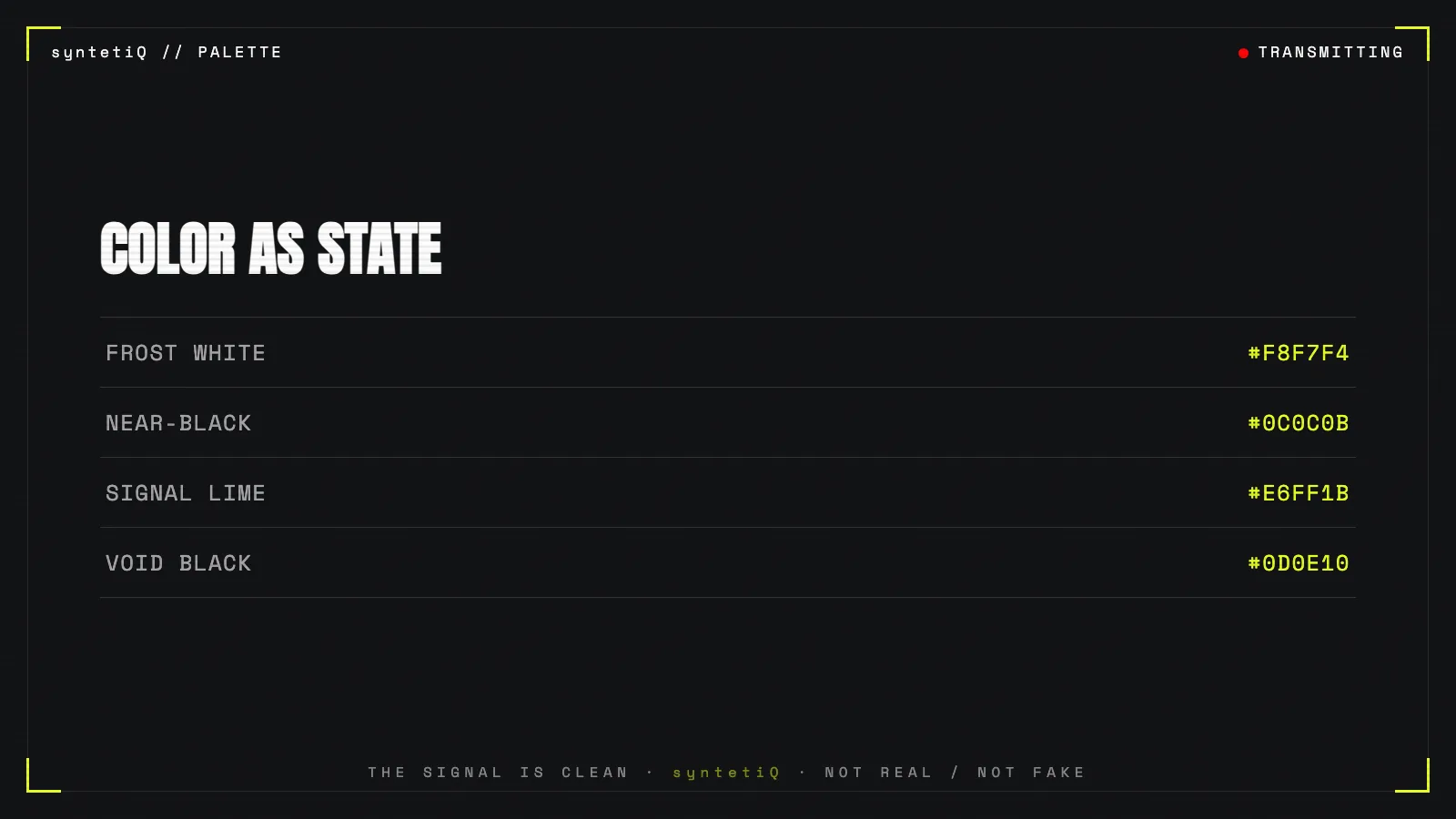
Color as State
The palette encodes meaning:
- Frost white (#F8F7F4): Operational default. Labs mode.
- Near-black (#0C0C0B): Primary text. Signal content.
- Cement (#B8B5B0): Secondary information. Dimmed state.
- Midgrey (#828078): Tertiary. Supporting data.
- Signal lime (#E6FF1B): Single activation per page. One dot. One line. One word. No more.
- Void black (#0D0E10): Contrast moments. Propaganda mode.
The Single Hot Dot Rule
Signal lime appears once per viewport. This is the law of scarce attention. The eye is drawn to scarcity. Multiple signals dilute to noise.
Applications of the hot dot:
- Status indicator in navigation
- Active state in calibration
- Single word highlight in headlines
No Gradients. No Rounded Corners.
Gradients imply transition, impermanence, emotion. The Labs aesthetic is fixed state. Binary conditions. Sharp edges communicate precision, clinical instruments do not have rounded corners.
Borders are 1px solid, never thicker. Hairline rules separate without dividing. The visual structure implies architecture: walls, floors, surfaces.
System Language
Communication follows patterns:
- Status codes: CALIBRATION OK / DRIFT DETECTED / SIGNAL HELD / OUTPUT LOCKED / SYNC:1 / AUTH:PASS
- Instructions: ALIGN THE SIGNAL / CUT THE NOISE / VERIFY INPUT / OBSERVE. LOG. REPEAT.
- System IDs: SNTQ-OK / LOG#042 / CRC:VALID / HASH:LIVE / MODE:STEEL
Every phrase is imperative or declarative. No questions. No hedging.
Negative Space is Active
Empty areas are not waiting to be filled. They are functional breathing room. The eye calibrates in negative space. Information density is controlled, too much signal creates interference.
The Lab Does Not Announce Itself
Labs pages have minimal navigation. No promotional language. The discovery is part of the experience, you found this. The system was here. It did not call for attention.
Directive: Deploy Labs aesthetic across all syntetiQ surfaces. Calibrate to frost white foundation. Measure output against precision standards.
Closure: Design system locked. Execution begins.