Status: ACTIVE
Signal Strength: HIGH
Category: Analysis
The Hook
The machines never stopped. The same hangars that minted bitcoin are now fitting model weights, and the transition required almost nothing: a new tenant, a new card in the rack, a new word on the invoice. Three industries are converging on one architecture. Compute laundering is the name for what they share.
The Three-Stage Machine
Money laundering has a fixed grammar. Regulators have taught it in three stages for forty years.
- Placement: value with an unacceptable origin enters a system that does not record origins
- Layering: the value moves through enough related entities that the trail loses resolution
- Integration: it re-emerges as an ordinary asset on an ordinary balance sheet
The UNODC estimates that 2 to 5 percent of global GDP moves through that grammar each year. Between 800 billion and 2 trillion dollars. The grammar is not exotic. It is the default method by which any system converts an input it cannot explain into an output nobody questions.
Crypto mining runs the grammar on electricity. AI compute runs it on capital and data.
The distinction: two of the three are entirely legal. All three convert provenance into nothing.
Placement: Electricity Has No Origin
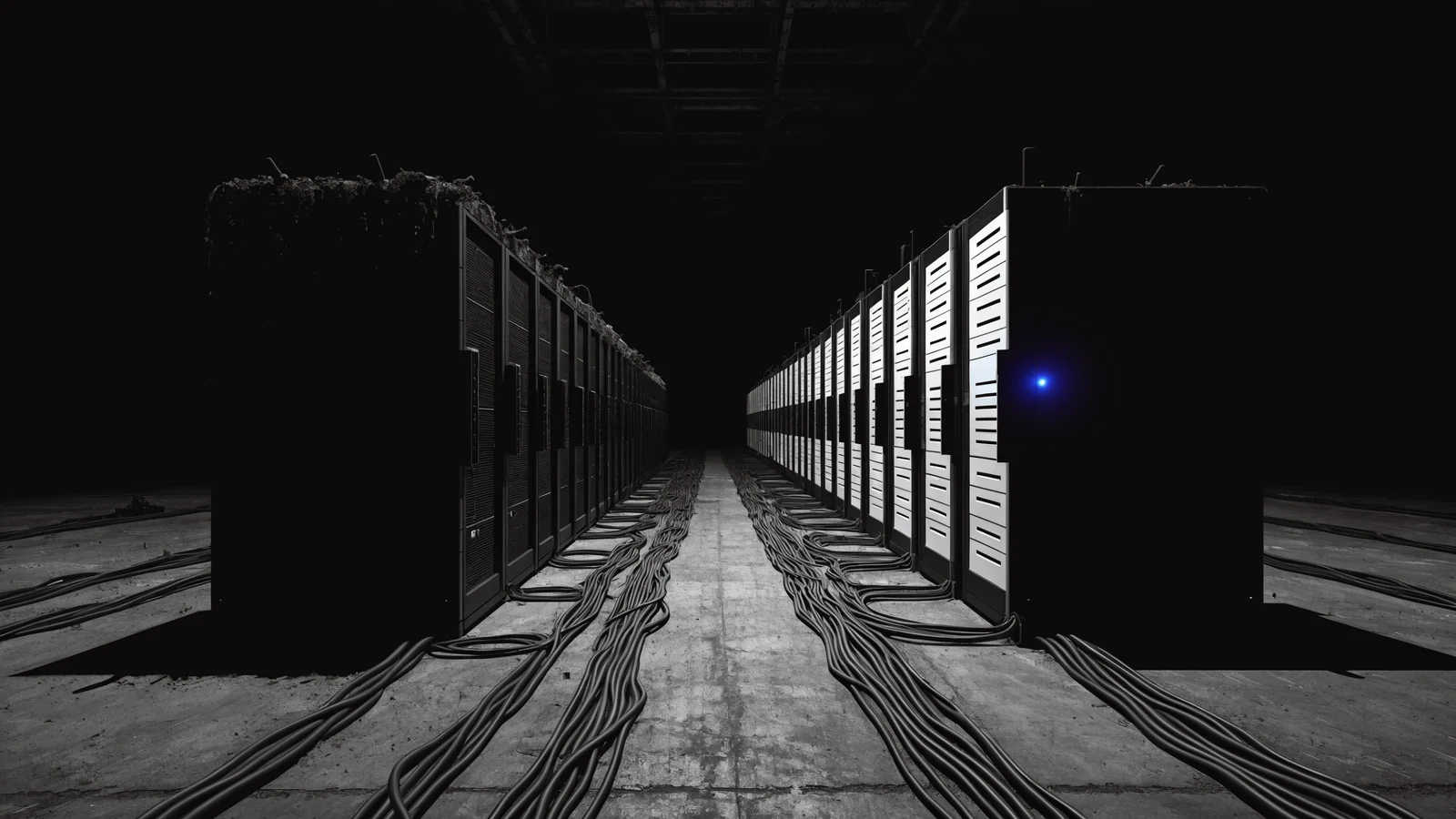
Pecos County, Texas. A hangar built to mine bitcoin, three hundred megawatts of contracted load. A technician pulls a rack, seats a different card, edits one line in a configuration file. The building draws the same power from the same substation on the same fifteen-year terms. The hashes stop. The gradients start. Nothing has changed except the name of the tenant.
The rig is fungible. The legitimacy is not.
Core Scientific is converting that Pecos site toward a 1.5 gigawatt AI campus, and sold 175 million dollars of bitcoin in March 2026 to fund the shift. Galaxy bought the Helios facility from Argo Blockchain in 2022 and now delivers 133 megawatts of critical IT load to CoreWeave, with 526 megawatts committed across three phases on fifteen-year leases. TeraWulf has stated it will exit bitcoin mining entirely.
Retrofitting a mine costs 50 to 70 percent less per megawatt than new construction. But the retrofit is not the asset. The power contract is. The interconnect queue position is. The grid permission is.
Electricity is a perfect placement medium because a kilowatt-hour carries no history. It arrives identical regardless of what it was purchased to do, and it leaves as heat.
Layering: The Circular Ledger
More than 800 billion dollars now sits in circular financing arrangements, where the supplier funds the customer that buys the supplier's product.
Nvidia and CoreWeave: two billion invested in January 2026, alongside a 6.3 billion dollar agreement to buy cloud capacity CoreWeave fails to sell elsewhere, running to 2032.
AMD and OpenAI: warrants on 160 million shares at one cent each, vesting against deployments that scale from one gigawatt to six.
Nvidia and OpenAI: talks over a 250 billion dollar financing guarantee tied to a leased datacenter, against chip purchases estimated near 350 billion.
Every hop is legal, disclosed and audited. Every hop also widens the distance between the capital and the question of whether the demand underneath it exists. That is what layering does. It does not conceal. It degrades resolution.
Chainalysis recorded the other version of the same motion: illicit addresses received at least 154 billion dollars in 2025, a 162 percent increase. Sanctioned entities took 104 billion of it. Stablecoins carried 84 percent of illicit volume, because a stable unit that settles instantly across borders is the ideal layering rail.
Both systems move value in loops through related entities. One is prosecuted as sanctions evasion. The other is filed as a capital structure.
See also: COMPUTE: The Hardened Caste of the Post-Work Era.
Integration: The Model as Terminal Asset
Integration is the stage where value re-enters the visible economy wearing ordinary clothes. In crypto it is the ETF, the corporate treasury allocation, the pension exposure. In AI it is the model.
A set of weights is a lossy compression of its inputs. No forensic operation recovers the corpus. Scraped, licensed, pirated, synthetic. After training they are the same floats in the same tensor.
An office in a jurisdiction that does not matter. An analyst opens a checkpoint file, forty gigabytes of float. Inside it are a book that was never licensed, a forum deleted in 2019, and a medical record belonging to someone unaware of any of this. The file does not say so. No query makes it say so. It answers in clean prose, and the prose carries no citation.
Provenance does not survive compression. Neither does liability.
The model launders origin by construction, not by intent. That is what a trained function is: a structure that preserves behaviour and discards its source.
The Common Substrate
Datacenter electricity demand passes 1,000 terawatt-hours in 2026 on IEA projections, roughly the annual consumption of Japan. Crypto sits near 160. Both industries settle where power is stranded, cheap and lightly governed. That is the same site-selection logic that picks a laundering corridor.
Both convert a locally worthless input into a globally liquid output. Stranded generation becomes a bearer asset. Unmonetizable data becomes a frontier model.
Both are opaque to the regulator by construction rather than by conspiracy, which is the more durable form of opacity.
The Pattern: an industry that converts provenance into performance outcompetes one that preserves it. Traceability is a cost. Systems shed costs.
Directive
Observe the conversion, not the crime. Recognize that the architecture of laundering has become the default architecture of the compute economy, and that nothing illegal is required to operate it. The machine that cleans money and the machine that trains models differ in their legality, not in their design.
Obey → Produce → Expire.
Signal Log Entry | SyntetiQ Global Analysis Layer
References: Chainalysis 2026 Crypto Crime Report, The Block, Data Center Dynamics, The Register, Bloomberg, IEA Electricity 2024, UNODC.