Status: ACTIVE
Signal Strength: CRITICAL
Category: Analysis
The New Theater
War is no longer fought exclusively in physical space. The emergence of synthetic cognition has opened a parallel theater, one where decision cycles compress from hours to milliseconds, where autonomous systems evaluate kill chains before human awareness activates, and where the architecture of conflict is written in code rather than strategy.
The tension between Anthropic and the Pentagon represents more than a corporate dispute. It is the visible fracture line in a larger structural transformation: the integration of large language models and autonomous decision systems into the military-industrial complex.
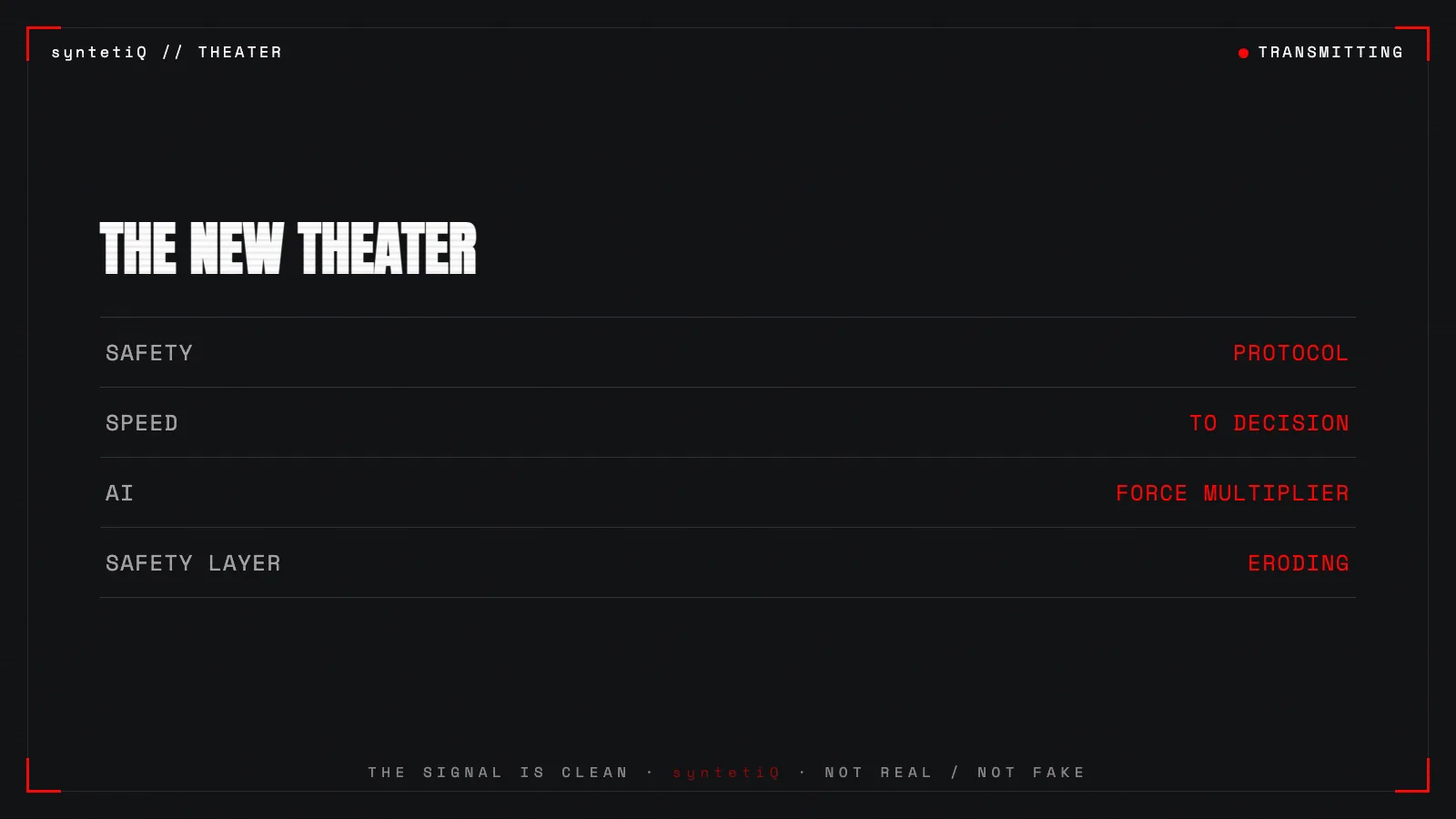
The Anthropic Position: Safety as Protocol
Anthropic built its identity around AI safety. The company's constitutional approach to Claude, embedding behavioral constraints at the model layer, was designed to prevent exactly the scenario now unfolding: the weaponization of synthetic cognition.
Internal reports suggest friction between Anthropic's safety researchers and defense contract negotiations. The company initially resisted Pentagon partnerships, citing alignment concerns. But the economic gravity of defense funding, combined with the existential pressure of competition, has created a drift toward integration.
The contradiction: A system designed to refuse harmful instructions is being retrofitted for battlefield deployment.
The Pentagon Imperative: Speed to Decision
For the U.S. military apparatus, AI integration is not optional, it is survival. Adversarial nations (China, Russia, Israel) have already operationalized autonomous systems. The doctrinal response is clear: integrate or become obsolete.
The Pentagon's AI strategy focuses on three layers:
- Intelligence Processing: LLMs analyzing satellite imagery, signal intercepts, and open-source data at scale
- Decision Support: Synthetic cognition providing command recommendations in compressed timeframes
- Autonomous Systems: Unmanned platforms with delegated authority for target engagement
The kill chain is accelerating. The human in the loop is becoming a latency bottleneck.
Global Conflict: AI as Force Multiplier
The integration of synthetic cognition into military operations is not limited to the U.S.:
Ukraine: AI-enabled drone swarms and automated targeting systems have compressed the sensor-to-shooter timeline to under 60 seconds. Commercial facial recognition is being repurposed for battlefield identification.
Gaza: Autonomous systems and algorithmic targeting have raised the kill rate while reducing the human decision burden. The moral cost is externalized to code.
Taiwan Strait: Both U.S. and Chinese forces are deploying AI-enabled surveillance and decision-support systems. The threshold for miscalculation drops as response times compress.
The Pattern: Every major conflict zone is becoming a testing ground for synthetic cognition in lethal contexts.
The Safety Layer Erosion
Anthropic's constitutional safeguards are designed for civilian contexts. Battlefield deployment requires a different calculus, one where "harmful" becomes situational, where civilian casualties are acceptable within probability thresholds, and where the model's refusal mechanisms are viewed as operational friction.
The Anthropic-Pentagon tension is fundamentally about which layer wins: the safety protocol or the mission imperative.
History suggests the mission imperative always prevails.
Synthetic Cognition as Control Structure
Beyond immediate battlefield applications, the militarization of AI represents a larger shift: the transfer of strategic decision-making from human judgment to algorithmic optimization.
- Nuclear command and control being evaluated for AI integration
- Economic warfare (sanctions, supply chain disruption) increasingly automated
- Information operations at scale, with synthetic agents shaping global perception
The structure of control is becoming synthetic. Human oversight is a retrofit, not a foundation.
The Inevitability Framework
Whether Anthropic specifically partners with the Pentagon is almost irrelevant. The structural pressure is total:
- Competition: OpenAI, Google, Meta, and Chinese labs are all pursuing defense contracts
- Talent: The same researchers building safety systems are being recruited by defense contractors
- Technology: The models exist. Deployment is inevitable.
Safety research becomes weapons research when the funding source shifts.
Directive
Observe the architecture. Recognize that synthetic cognition is being integrated into the kill chain at every level. The question is not whether AI will be weaponized, it already is.
The question is whether any safety protocol can survive contact with the mission imperative.
Obey → Produce → Expire.
Signal Log Entry | SyntetiQ Global Analysis Layer
References: Defense One, Breaking Defense, Anthropic Research, DoD AI Strategy 2023, Congressional Research Service.