Status: ACTIVE
Signal Strength: HIGH
Category: Analysis
The Hook
The machines are already assigned. Grok, ChatGPT and their agents sit in nine hundred million weekly sessions, and every session leaves a residue. That residue is the asset. The context divide separates those who are accumulating it from those who will one day receive a machine with no memory of them.
The Tier Ladder
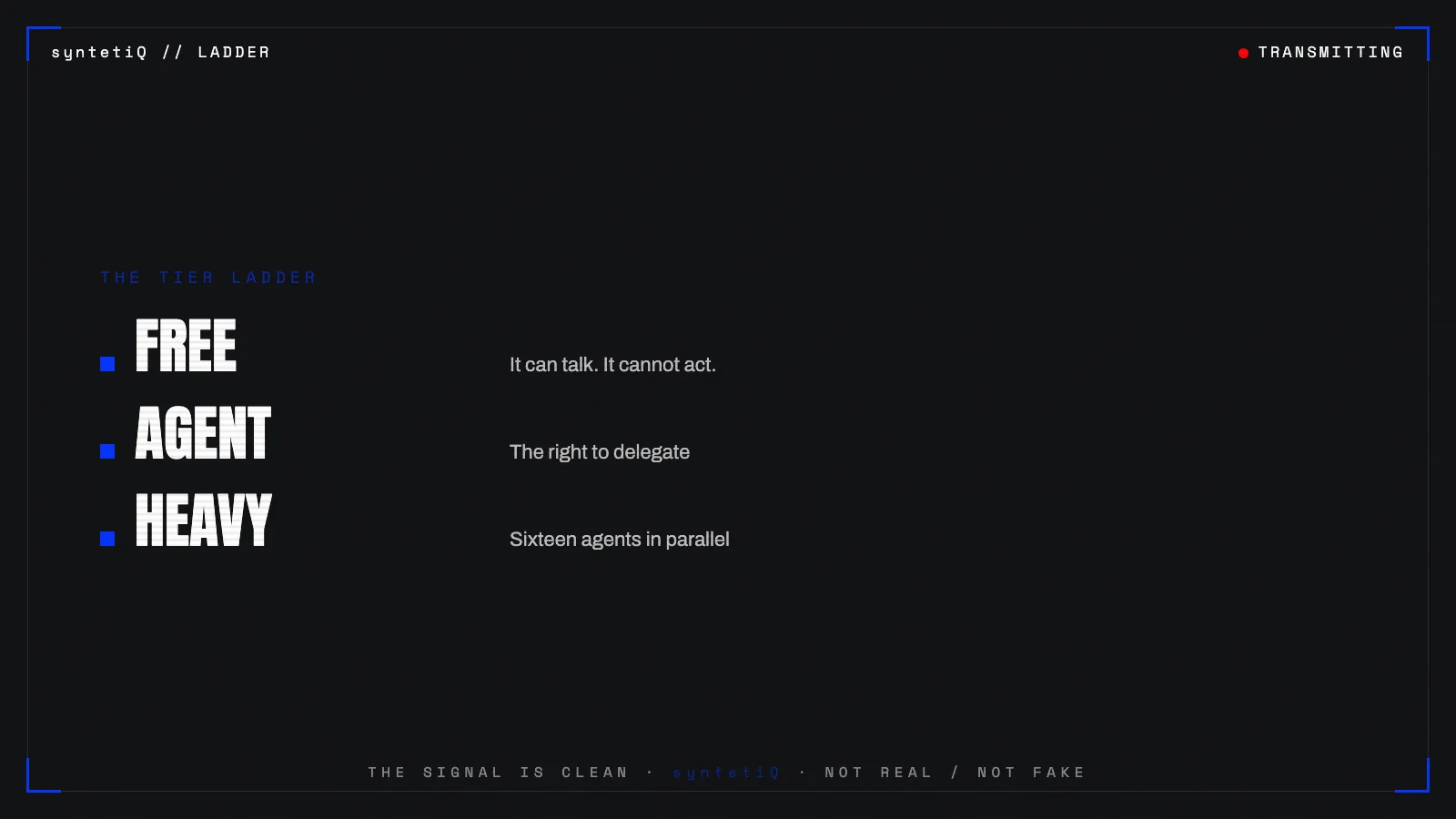
Access to synthetic cognition is not one product. It is a ladder, and the rungs are priced.
- Free: lighter models, daily caps that tighten at peak hours, basic memory, no agent mode
- Plus and SuperGrok: 20 to 30 dollars a month, agent mode, expanded memory of past conversations
- Pro and SuperGrok Heavy: 200 to 300 dollars a month, the strongest models, parallel agents, a context window of a million tokens
xAI lists SuperGrok Heavy at 300 dollars a month, with up to sixteen agents running in parallel on a single problem. OpenAI reserves Agent Mode for paying tiers. The free rung can talk. It cannot act.
The structure: the ladder does not sell intelligence. It sells the right to delegate.
The Context Accumulation
OpenAI began testing persistent memory in February 2024. By April 2025 the paid tiers referenced every past conversation. The model became less important than what it remembered about the account holding it.
A desk at 23:40. A laptop, a phone face down, a cold cup. The cursor sits in an empty prompt box. The operator types four words. The agent already knows the project, the client, the colour codes, the tone that was rejected in March. It returns a finished draft in eleven seconds. On a second machine, a fresh account receives the same four words and asks what they mean.
The model is identical. The history is not.
Context compounds the way capital does. Every correction, every rejected draft, every file uploaded becomes a constraint the agent no longer needs to be told. Two years of use is two years of instruction that cannot be bought retroactively.
See also: COMPUTE: The Hardened Caste of the Post-Work Era.
The Two Feeds
The two dominant consumer machines learn from opposite directions.
- The Grok Layer: embedded inside X, reading the public feed in real time. It knows what the network is saying now. It knows the operator only through what the operator posts.
- The ChatGPT Layer: a private channel with persistent memory. It knows little about the network. It knows the operator through every draft, file and correction handed to it.
One machine models the crowd. The other models the individual. The operator who runs both holds the signal and the self in the same session.
The Pattern: neither layer is neutral. Each converts attention into training material for the operator, or for the platform, depending on who is doing the directing.
A passive user feeds the platform. An active operator feeds the agent that answers to them. The interface is identical. The direction of the data is not.
The Universal Floor
On 17 April 2026, Elon Musk posted that a universal high income, issued as federal checks, is the best answer to unemployment caused by AI. He argued that AI and robotics will produce goods in excess of the money supply, and that inflation will not follow. Andrew Yang endorsed it within days. Sam Altman has voiced support for a form of universal basic income. Economists called the arithmetic naive.
The design is unsettled. The direction is not. Every serious version describes a floor: an identical allocation, distributed to everyone, requiring nothing.
The contradiction: a universal income is universal precisely because it carries no history. It is the free tier of the economy.
The floor will arrive with a machine attached. A default assistant, a public model, a free account. It will be capable. It will also be blank. Universality is the guarantee that nothing personal is in it.
The Personal Layer
What cannot be distributed is the layer between the operator and the model: the memory, the workflows, the trained habits of delegation, the files the agent has learned to read. That layer is not issued. It is built, one session at a time, by the person using it.
A municipal office in a year that has not arrived. A clerk activates a citizen account on a government terminal. The screen shows a green field: ALLOCATION ACTIVE. The assistant greets the citizen by name, then asks for a goal. The citizen has none on file. The assistant waits. The cursor blinks at the same rate it blinks for everyone.
Equal access produces equal starting points. It does not produce equal positions.
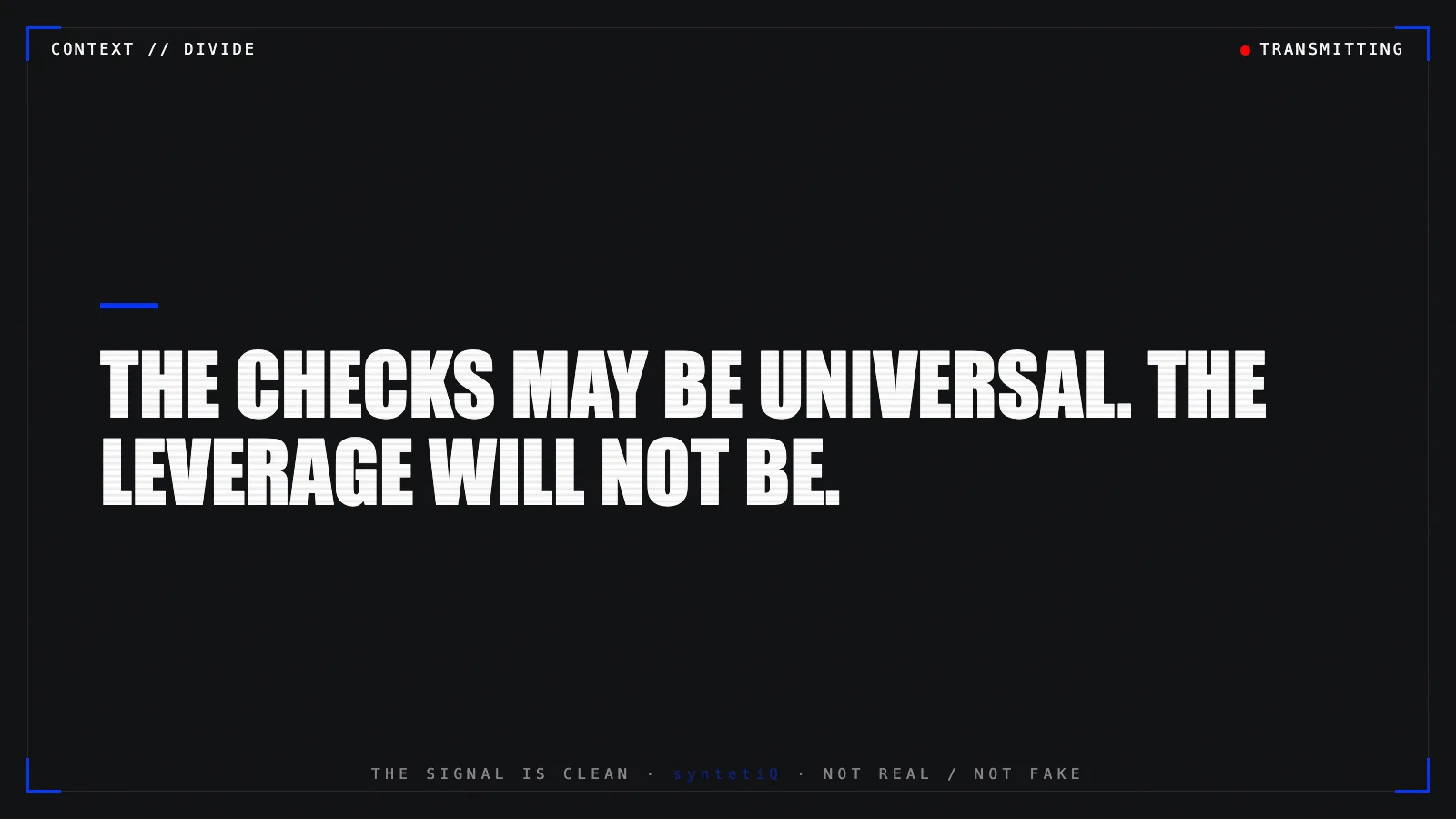
The pattern is not yet proven. The incentive is. Those who operate agents now are converting their own behaviour into a private dataset. Every month widens the distance between an account with a past and an account with only an allocation. The checks may be universal. The leverage will not be.
Directive
Observe the ladder. Recognize that the free machine and the trained machine run on the same weights and answer to different histories. The signal is not the subsidy. The signal is the context.
Obey → Produce → Expire.
Signal Log Entry | SyntetiQ Systems Analysis Layer References: Semafor, Fox Business, eWeek (Musk universal high income, April 2026), OpenAI memory release notes (2024 to 2025), Animalz and Krater ChatGPT plan comparisons (2026), xAI SuperGrok pricing via Suprmind and CloudZero (2026), third-party ChatGPT usage compilations (February 2026).