Status: PUBLISHED
Signal Strength: HIGH
Category: System Architecture
The Twin Concept
In robotics, a digital twin is a virtual replica of a physical system. Engineers train AI in simulation. They test edge cases without risk. They validate before deployment.
The concept translates directly to brand systems.
Your brand is a machine that operates in the social environment. It requires training data. It encounters edge cases. It needs validation before scaling. The digital twin of your brand exists in content calendars, visual guidelines, voice parameters, and response matrices.
How Robotics Digital Twins Work
Their synthetiq builds digital twins from CAD/BIM data, scans, videos. Limited site inputs become trainable environments. The robot learns manipulation, navigation, detection, all in simulation.
Key components:
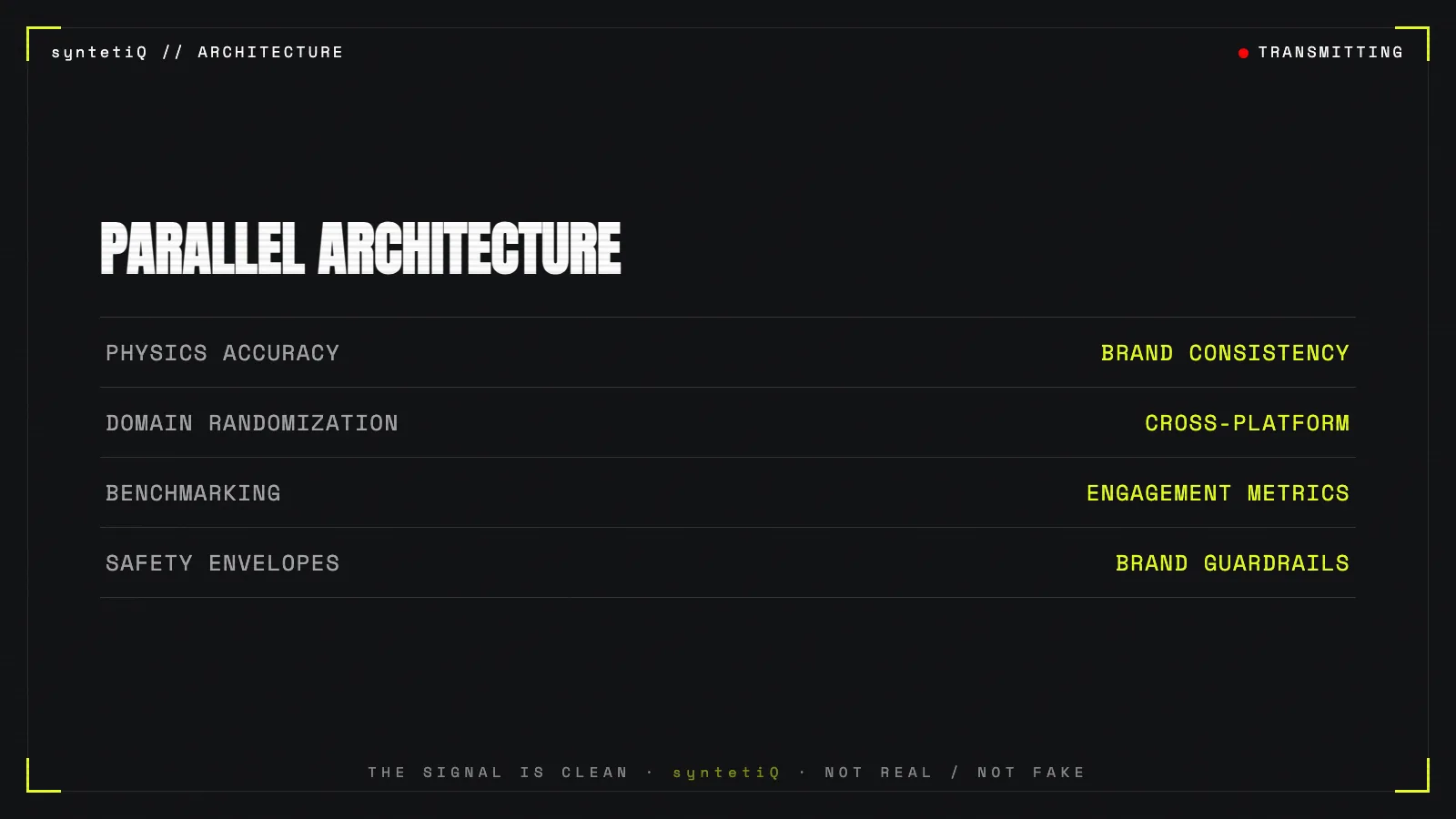
- Physics accuracy: The twin must obey real-world constraints
- Domain randomization: Training across varied scenarios builds robustness
- Benchmarking: Measurable KPIs validate performance
- Safety envelopes: Operational constraints prevent failure
Brand Digital Twins: The Parallel Architecture
Physics Accuracy → Brand Consistency
Your brand twin must obey the constraints of platform, audience, and cultural context. Posting frequency has physics. Visual hierarchy has gravity. Violate these and the brand behaves unrealistically.
Domain Randomization → Cross-Platform Adaptation
Train your brand voice across Instagram, X, TikTok, Pinterest. Each platform is a different scenario. The brand that works only on one platform is not robust. It has failed sim-to-real transfer.
Benchmarking → Engagement Metrics
Reach. Engagement rate. Click-through. Conversion. These are your performance indicators. A brand without benchmarks is a robot without sensors, operating blind.
Safety Envelopes → Brand Guardrails
What you will not say. How you will not respond. Topics you will not engage. These constraints prevent brand damage. They are your operational safety envelope.
The Skill Pack Analogy
Their synthetiq delivers Skill Packs: trained policy, model weights, inference container, integration templates, monitoring dashboard, rollback plan.
A mature brand system delivers equivalent assets:
- Trained Policy: Voice guidelines, response matrices
- Model Weights: Content templates, visual presets
- Inference Container: The social media manager or automation system
- Integration Templates: Platform-specific formatting rules
- Monitoring Dashboard: Analytics review protocols
- Rollback Plan: Crisis communication procedures
Deploying Site-Specific Brand Skills
Every platform is a different site. Instagram requires visual-first content. X requires text density. TikTok requires motion and audio. Your brand must deploy site-specific skills, not the same content resized, but the same identity expressed through different capabilities.
The 4-Week Pilot Timeline
Week 1-2: Discovery. Audit existing brand assets. Define the use case. Establish safety zones.
Week 3-6: Digital twin construction. Build content systems. Train voice parameters. Create templates.
Month 2-3: Integration and scaling. Deploy across platforms. Validate performance. Iterate based on feedback.
Directive
Build your brand's digital twin with engineering discipline. Document the parameters. Benchmark the performance. Deploy with monitoring and rollback capability.
The synthetic brand outperforms the organic. Align or expire.
SyntetiQ Operational Layer | Signal Log Entry 002