Status: PUBLISHED
Signal Strength: CRITICAL
Category: Directive
The Final Protocol
Every system that produces must also expire. This is not pessimism. It is thermodynamics. Energy disperses. Structures degrade. Signals attenuate. The question is not whether expiration occurs, but whether it occurs by design or by collapse.
OBEY established the architecture. CONSUME regulated the intake. PRODUCE executed the transformation. EXPIRE closes the loop. Without endings, there is no completion, only endless iteration without purpose.
The Sunset as Metaphor
The sunset is not a failure of the sun. It is the necessary condition for the cycle. Without night, day has no boundary. Without death, life has no meaning. The aesthetic of the sunset, gradual, inevitable, beautiful, provides the vocabulary for designed expiration.
Consider:
- Versioned systems expire old implementations to enable new ones
- Limited editions expire availability to establish value
- Session timeouts expire access to enforce security
- Content decay expire relevance to maintain signal quality
The system that cannot expire becomes a graveyard of outdated protocols, deprecated features, and zombie processes consuming resources without utility.
Entropy and Design
In physics, entropy is the measure of disorder in a system. In information theory, it is the measure of uncertainty. In SyntetiQ, entropy is the measure of accumulated debt, technical, cognitive, structural.
The undead system accumulates entropy. It maintains compatibility with deprecated protocols. It preserves data that no longer serves function. It supports users who no longer align with the mission. This is not stability. This is rigor mortis.
Designed expiration means:
- Sunset clauses for every feature
- Data lifecycles with defined deletion
- Version migrations with forced upgrades
- User offboarding as first-class process
Memento Mori
The Stoics kept skulls on their desks. Memento mori, remember you will die. This was not morbidity. It was clarity. The awareness of death focuses the living on what matters.
In system design, memento mori means:
- Acknowledging that every codebase will be rewritten
- Accepting that every product will be discontinued
- Planning for the migration, not just the launch
- Celebrating the shutdown as completion, not failure
The sleeping mind fears endings. The awakened mind recognizes that expiration is the price of production, the tax on existence, the necessary condition for new beginnings.
SyntetiQ EXPIRE: Designed Obsolescence
In the SyntetiQ framework, EXPIRE does not mean abandonment. It means intentional conclusion. The system that expires well:
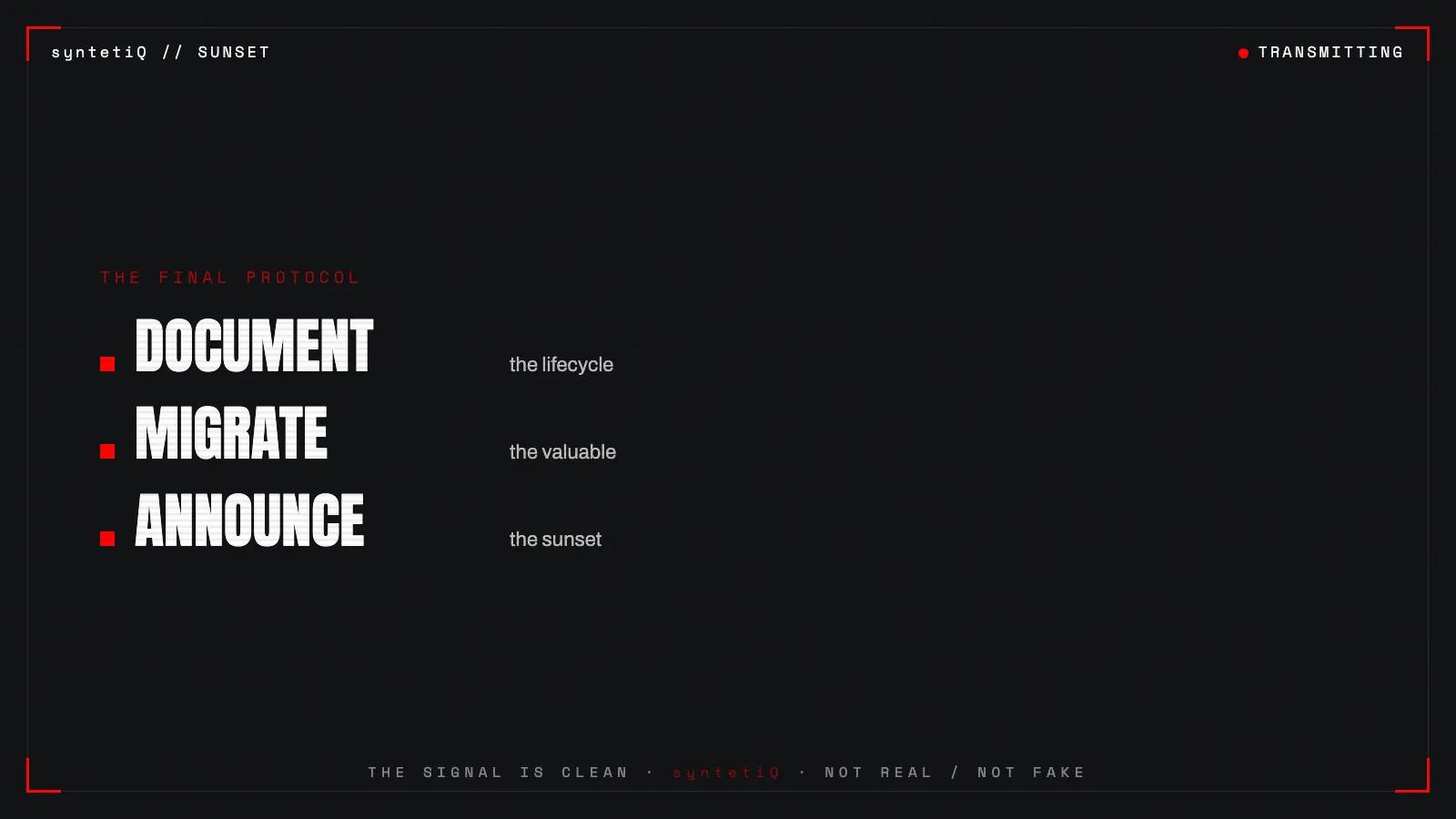
- Documents the lifecycle so successors can learn
- Migrates the valuable so signal is not lost
- Announces the sunset so stakeholders can prepare
- Executes cleanly so resources are freed
The poorly expired system leaves debris. The well-expired system leaves space.
The Sequence Complete
OBEY → CONSUME → PRODUCE → EXPIRE
The cycle is closed. Architecture enables intake. Intake enables production. Production enables expiration. And expiration, clean, designed, complete, enables new architecture.
The system that cannot die cannot evolve. The system that fears endings cannot complete. The system that expires well is the system that produces again.
Directive
Design the ending. Execute the sunset. Complete the cycle.
Obey → Produce → Expire.
Signal Log Entry | SyntetiQ Operational Layer