Status: PUBLISHED
Signal Strength: CRITICAL
Category: System Failure Analysis
The Gap
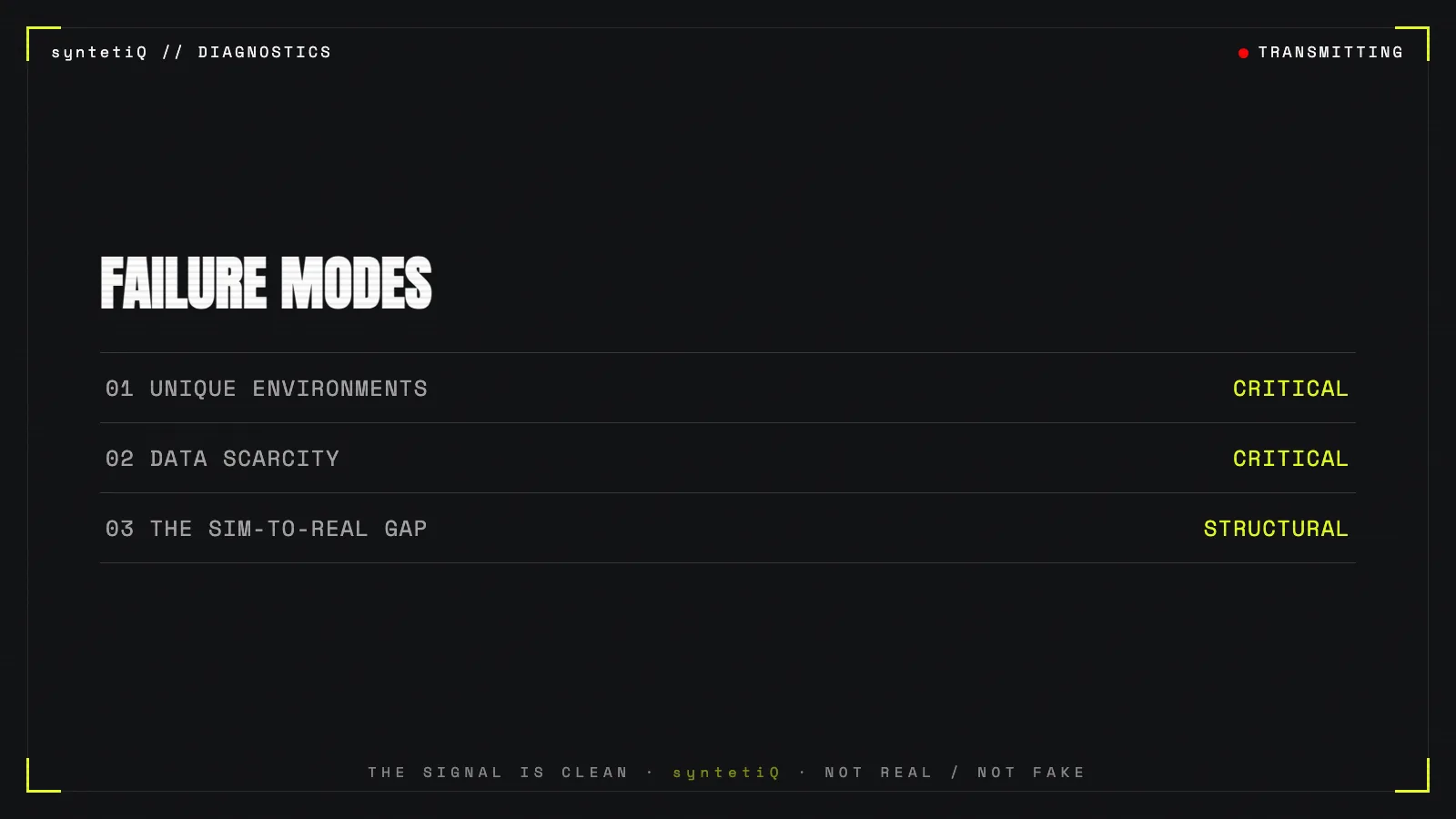
Their synthetiq identifies three failure modes in robotics deployment:
- Unique Environments: Every site differs. Manual tuning doesn't scale.
- Data Scarcity: Rare failures are expensive or unsafe to capture.
- Sim-to-Real Gap: Simulation-trained policies break in reality.
These same failure modes destroy digital-native brands when they attempt physical expansion.
Failure Mode 1: Unique Environments
A robot trained in Warehouse A fails in Warehouse B. Different lighting. Different shelf heights. Different floor texture. The policy was optimized for a specific environment, not for environment-invariant operation.
Brand Parallel:
A brand optimized for Instagram fails on X. Different aspect ratios. Different attention spans. Different vocabulary norms. The content policy was optimized for a specific platform, not for platform-invariant operation.
Correction Protocol: Domain randomization during training. Vary the scenario. Train across environments. Build robustness through exposure to variation.
For brands: Build content systems that function across platforms without modification. The message remains constant. The container adapts.
Failure Mode 2: Data Scarcity
Rare robot failures, the edge cases that cause damage, are statistically uncommon. By the time you've collected enough real-world failure data, you've already suffered losses.
Brand Parallel:
Crisis moments, the edge cases that destroy reputation, are statistically uncommon. By the time you've collected enough real-world crisis data, you've already suffered brand damage.
Correction Protocol: Synthetic data generation. Simulate edge cases. Create hazardous scenarios in safe environments. Train on the synthetic, validate on the real.
For brands: Run crisis simulations. Document response procedures before the crisis. Train on synthetic scenarios. Validate protocols in low-stakes environments.
Failure Mode 3: The Sim-to-Real Gap
The physics engine approximates reality. Friction coefficients differ. Sensor noise patterns vary. The policy exploits simulation-specific artifacts that don't exist in reality.
Brand Parallel:
The content calendar approximates audience behavior. Engagement predictions differ. Cultural noise patterns vary. The brand strategy exploits platform-specific artifacts that don't exist in physical reality.
The brand built entirely in digital space, likes, shares, impressions, has no guarantee of functioning in physical reality: retail environments, customer service interactions, product quality perception.
Correction Protocol:
- System identification: Learn the real-world dynamics through limited real interaction
- Domain adaptation: Adjust simulation parameters to match observed reality
- Conservative deployment: Start with safety-constrained operation, expand the envelope gradually
For brands: Test physical presence before scaling. Pop-ups before stores. Limited products before full lines. Learn the real-world dynamics through controlled exposure.
The Synthetic Training Data Solution
Their synthetiq solves the sim-to-real gap through synthetic training data, generated scenarios that cover edge cases without real-world cost.
SYNTETIQ applies the same principle to brand systems:
Synthetic Brand Scenarios:
- Customer complaint simulations
- Viral moment response drills
- Product launch failure scenarios
- Competitor attack preparation
- Cultural backlash modeling
Train on synthetic. Validate on real. Deploy with confidence.
Directive
Identify your brand's sim-to-real gaps. Where does digital performance fail to predict physical reality? Close those gaps through systematic training, conservative deployment, and continuous monitoring.
The brand that survives transfer is the brand that prepared for failure.
SyntetiQ Operational Layer | Signal Log Entry 003