Status: PUBLISHED
Signal Strength: HIGH
Category: Culture Analysis
The Origin Point
- Lafayette Street, Manhattan. James Jebbia opens a skate shop. The location matters, near the Supreme Court, the name borrowed from institutional authority. This is not irony. It is calibration.
The skateboarders who gather here understand being watched. Security cameras. Police. The gaze of property owners. Supreme emerges from this culture of surveillance, of skaters filming each other, documenting tricks, distributing evidence of skill across VHS tapes and early internet forums. The brand becomes the uniform of those who know they are observed.
Manufacturing Divergence
While competitors chase minimum cost through Bangladesh and Vietnam, Supreme sources heavyweight fleece from CYC Design Corporation in Canada. The hoodies carry weight. The cotton is dense. This is not charity, this is structural integrity. Quality as signal. The Canadian-made pieces become artifacts, distinct from the disposable garments flooding discount retailers.
The CYC-era Supreme box logos remain the gold standard among collectors. Made in Mississauga, Ontario, these pieces represent a rejection of the race-to-the-bottom manufacturing model that dominates fast fashion. When competitors were cutting costs, Supreme was investing in fabric weight and construction quality.
The Architecture of Scarcity
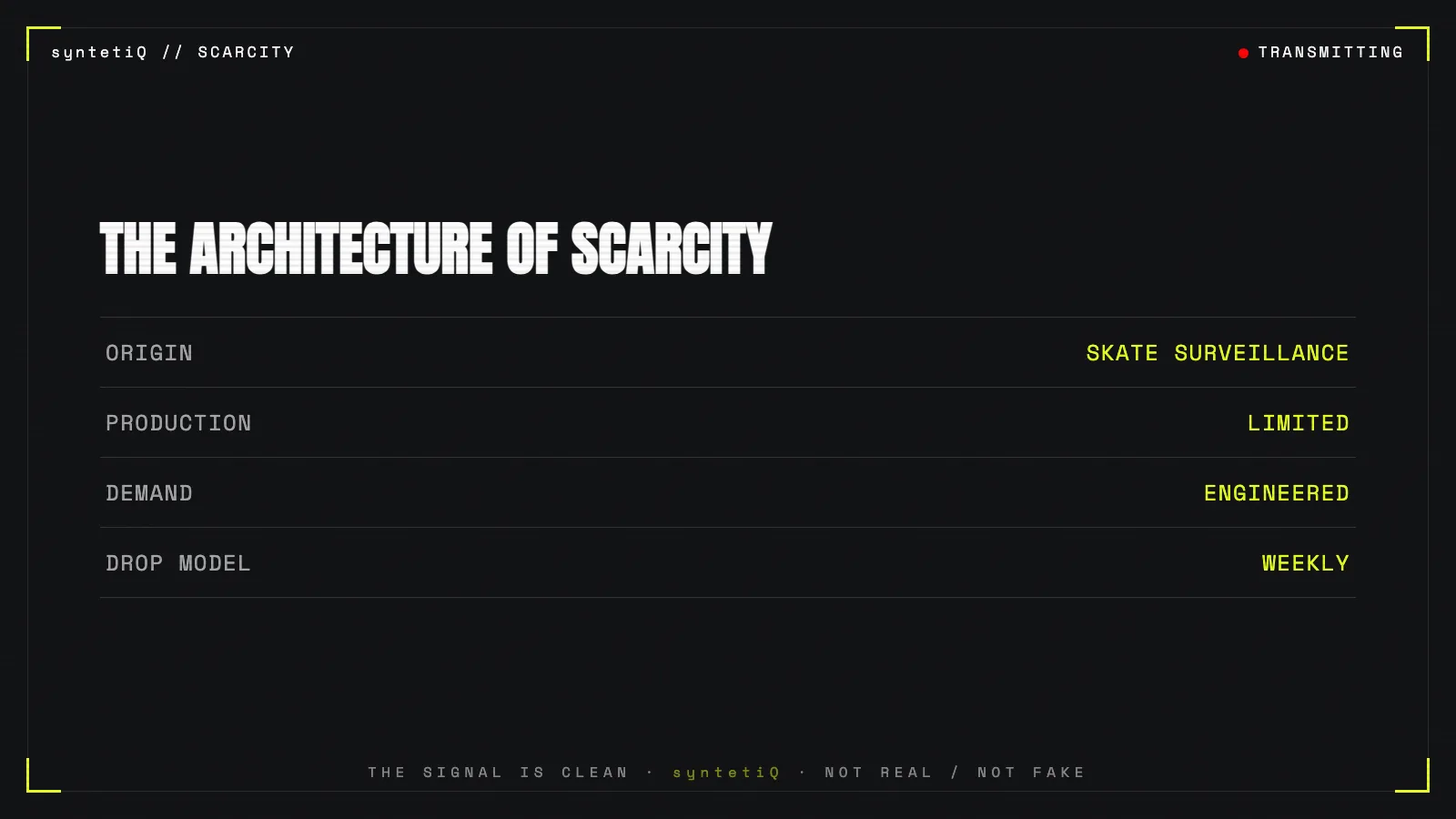
The "drop" system emerges: limited releases, unannounced times, lines forming outside stores, cameras everywhere. Consumers become participants in their own observation. They document themselves wearing the brand. The red box logo functions as a beacon, identifying the wearer as part of the watched collective.
This is surveillance flipped. The watched become performers. The security footage becomes marketing material. The scarcity engineered through limited production creates secondary markets where authenticity commands premium pricing.
The Contradiction
The brand built on anti-establishment skate culture becomes establishment. The surveillance that once threatened skaters now markets to them. Security footage becomes hype video. The watched become the watchers.
Manufacturing shifts over time, not everything remains Canadian-made. Quality variance becomes another signal. The originals, the CYC-era pieces, gain cult status. Scarcity compounds through time as much as through production limits.
The Signal
Supreme's trajectory reveals a pattern: systems of control produce their own aesthetics. Skate culture developed uniform and signaling mechanisms in response to surveillance. Those mechanisms became desirable to outsiders. The signal spread. The system absorbed its own opposition.
The lesson is not about authenticity or selling out. It is about how resistance generates style, and style generates markets, and markets eventually consume even the concept of resistance itself.
Directive
Observe what systems of control produce. Wear the evidence. The loop is the product.
Signal Log Entry | SyntetiQ Cultural Analysis Layer