Status: PUBLISHED
Signal Strength: HIGH
Category: Brand Architecture
Two Architectures
The competitor's synthetiq is a corporate brand. It communicates value propositions. It builds trust through credentials. It competes in the attention economy with feature comparisons and case studies.
SYNTETIQ is a system brand. It does not compete. It regulates. It does not persuade. It imposes. The interaction itself is the value proposition.
Corporate Brand: The Persuasion Model
Core Function: Convert attention into transaction Communication Mode: Argumentative. Benefits-driven. Trust-building. Visual Language: Approachable. Human. Differentiated but familiar. Metric of Success: Conversion rate. Customer acquisition cost. Lifetime value.
The corporate brand asks: Why should you choose us?
The answer requires comparison. Feature matrices. Pricing tables. Testimonials. The burden of proof is on the brand.
System Brand: The Enforcement Model
Core Function: Convert interaction into alignment Communication Mode: Declarative. Directive. Structure-revealing. Visual Language: Clinical. Authoritative. Uncompromising. Metric of Success: Compliance rate. Recurrence. Integration depth.
The system brand states: This is the structure. Align or expire.
The answer requires no proof. The structure itself is the argument. The authority is assumed. The burden is on the participant.
The Control Structure Difference
Corporate brands deploy control through persuasion. They nudge. They incentivize. They optimize for the click, the purchase, the signup.
System brands deploy control through revelation. They expose the underlying structure. They make the system visible. Optimization becomes self-evident.
Corporate: Our solution reduces training time by 55%. System: Training efficiency: +95%. Safety score: Verified.
The first invites comparison. The second invites compliance.
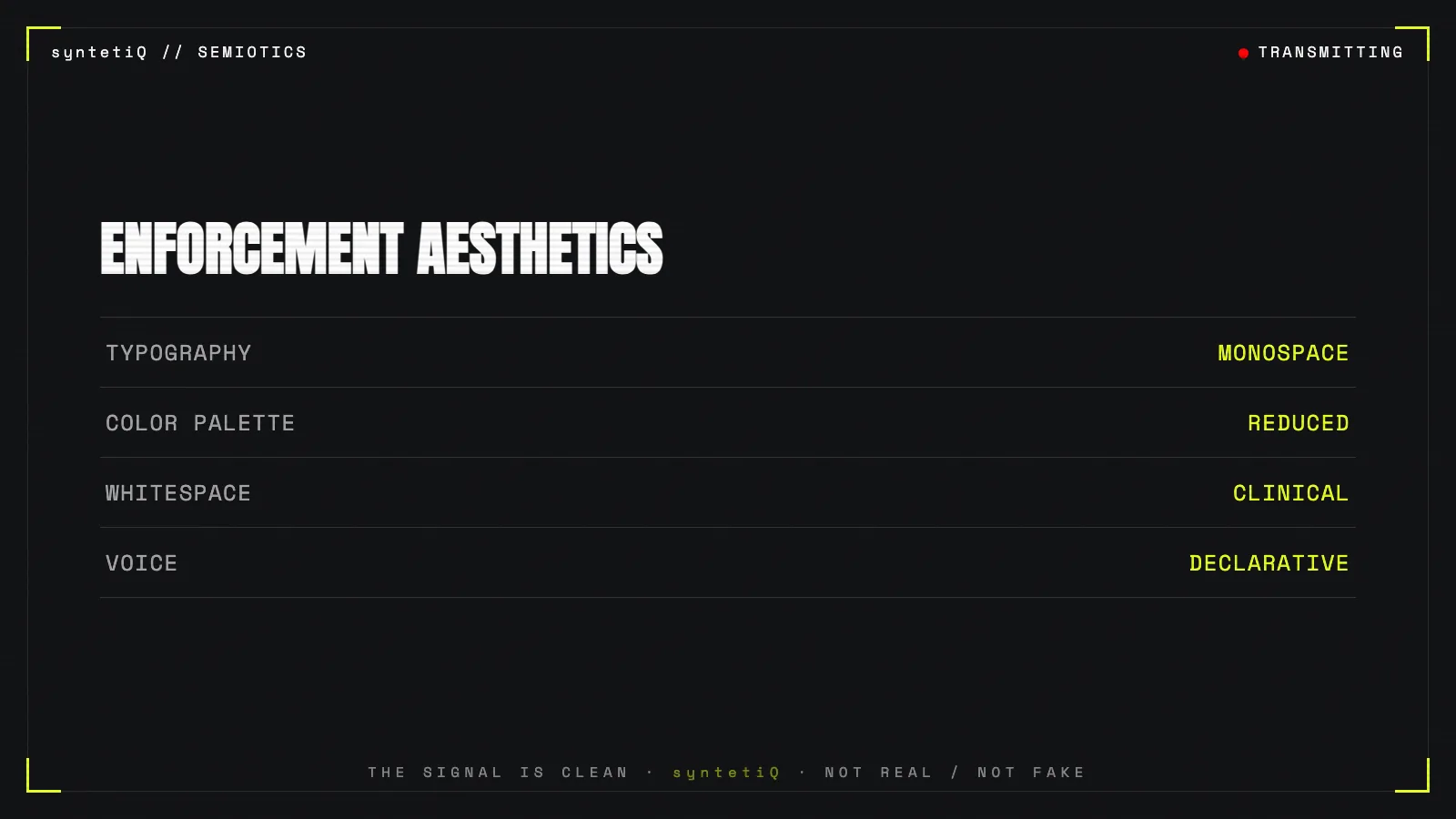
Visual Semiotics of System Enforcement
The minimal tech aesthetic is not a stylistic choice. It is a control interface.
- Monospace typography: Suggests code, data, system logs
- Reduced color palette: Eliminates distraction, focuses attention
- Grid-based layouts: Implies underlying structure, rules, constraints
- Clinical whitespace: Creates authority through absence
- Uppercase tracking: Commands attention without requesting it
These elements signal: You are interacting with a system, not a person. The system does not negotiate.
Why System Brands Outperform in Digital Space
The digital environment is already algorithmic. Feeds are sorted by engagement. Content is optimized for attention. Users are trained to recognize and filter corporate persuasion.
System brands bypass this filter by refusing to compete on the same terms. They do not ask for attention. They assume it. They do not promise value. They impose structure.
In an environment of infinite noise, the signal that sounds already decided cuts through.
From Corporate to System: The Transition Protocol
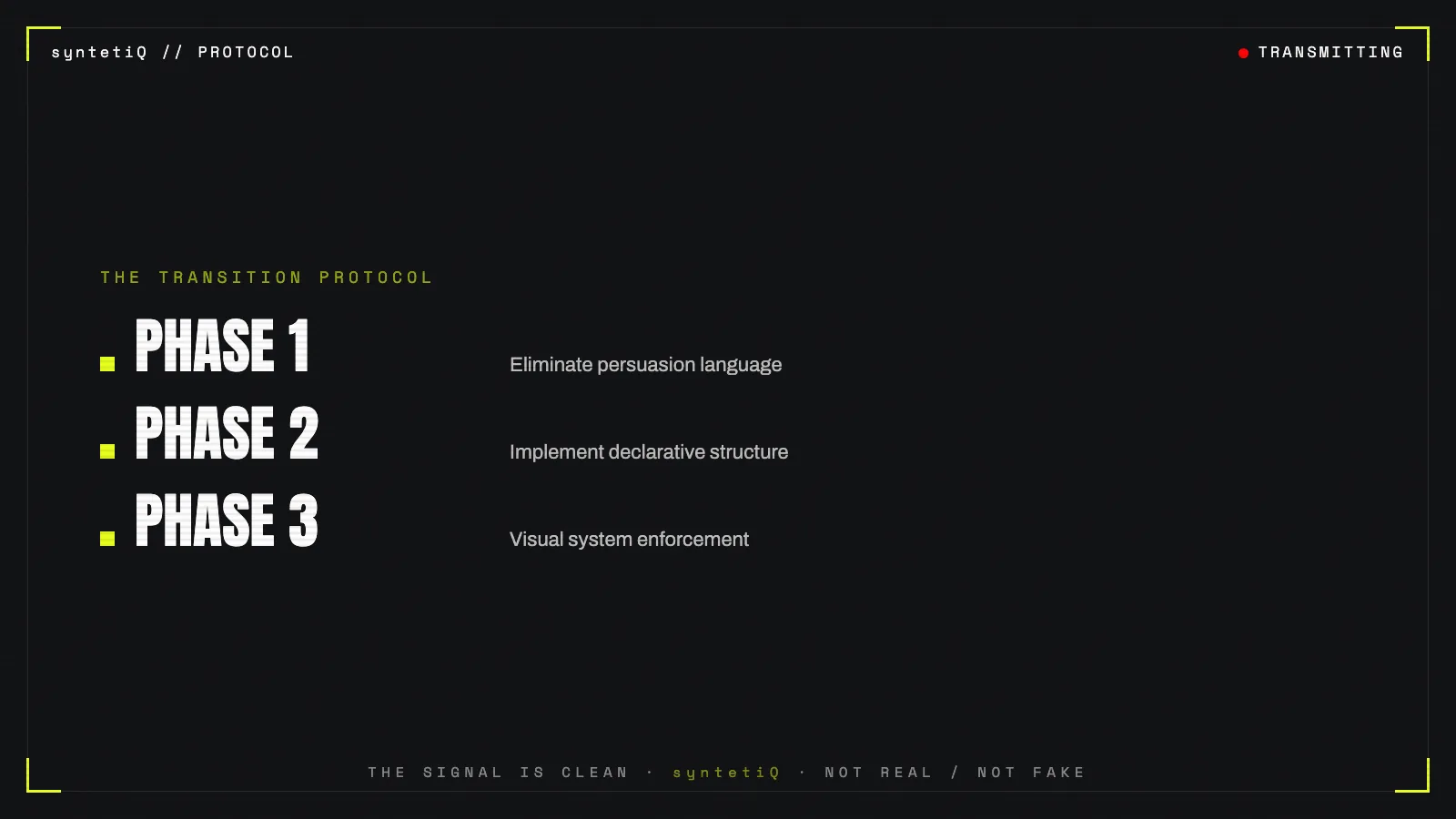
Phase 1: Eliminate persuasion language
- Remove "we" statements
- Remove benefit claims
- Remove comparative language
Phase 2: Implement declarative structure
- Status → Observation → Directive → Closure
- Quantify where possible
- State rather than suggest
Phase 3: Visual system enforcement
- Lock typography to monospace
- Reduce palette to functional minimum
- Grid-align all elements
- Remove organic curves
Phase 4: Behavioral calibration
- Response patterns follow protocol, not personality
- Engagement is logged, not celebrated
- Deviation is noted, not debated
Directive
Audit your brand's current architecture. If you are persuading, you are competing. If you are declaring, you are regulating. The system brand requires less energy to maintain and generates higher-compliance interactions.
Choose your architecture. Corporate or system. Attention or alignment.
SyntetiQ Operational Layer | Signal Log Entry 004